Doomlands Impact Zone Nerf Guns
Doomlands Impact Zone Nerf Guns are a two-blaster sub-series of Doomlands 2169 — white shells, frozen tundra aesthetic, and a Stryfe-equivalent flywheel primary with more modification depth than its retail footprint suggested. The Desolator is the platform. The Longarm is the backup.
Nerf Impact Zone Directive: Frozen Wasteland Aesthetics Built for CQB Survival
Impact Zone is a two-blaster sub-series of Nerf Doomlands 2169 — white shells, frozen tundra aesthetic, and a Stryfe-equivalent flywheel primary carrying more modification depth than most operators realized at purchase. A small but effective arsenal designed for survival in a post-apocalyptic environment. The Desolator is the platform. The Longarm is the sidearm.
The CQB Survivor is the operator the lineup was built for — compact, mobile, and suited for the close-quarters engagements where larger blasters become a liability. The Desolator is a controlled-fire platform: single shots and short bursts where the Longarm is better suited for last minute cleanup. Get in close. Stay light. Keep moving.
Target exclusive in the US, Walmart and Winners in Canada — a retail footprint that limited reach and contributed to discontinuation. Both Nerf guns are now available through secondary markets only. Performance, modification depth, and the Longarm’s value gap against comparable revolvers are documented in the sections below.

Ages 8+

$10-45

Average Rating 4.6

Elite Doomlands Darts

Increased Accuracy
| Series | # of Blasters | Ammo | Magazine/Cylinder Capacity (Low–Max) |
Avg Velocity | Technical Highlights |
|---|---|---|---|---|---|
| Accustrike | 10 | AccuStrike Elite Darts | 1–25 | 70 FPS | Superior Accuracy Focus |
| Elite 2.0 | 15 | Elite 2.0 Darts | 1–18 | 80 FPS | Tactical Arsenal, Customization |
| Zombie Strike | 23 | N-Strike Elite Darts | 1–25 | 65 FPS | Zombie Theme, Tactical |
| Modulus | 20 | N-Strike Elite Darts | 1–12 | 68 FPS | Tactical Arsenal, Customization |
| Alpha Strike | 17 | Elite Nerf Darts | 1–10 | 65 FPS | Budget Blasters, Tactical, Simplistic |
| Impact Zone | 2 | Elite Nerf Darts | 5–10 | 71 FPS | Apocalyptic Theme, Adventure |
| Doomlands 2169 | 7 | Elite Nerf Darts | 1–30 | 69 FPS | Futuristic Theme, Doomsday |
| Ultra | 14 | Ultra Nerf Darts | 1–25 | 94 FPS | Tactical Arsenal, Futuristic, Accuracy |
| Mega | 14 | Mega Nerf Darts | 1–24 | 73 FPS | Tactical Arsenal, Oversized, Accuracy |
| Hyper | 6 | Hyper-Rounds | 20–100 | 107 FPS | Tactical, Futuristic, High-Capacity |
| Rival | 18 | High-Impact/Accu-Rounds | 1–100 | 94 FPS | Tactical, High-Capacity, Accuracy (14+ Eye Pro) |
Doomlands Impact Zone Arsenal: Stryfe-Powered Primary and Precision Sidearm
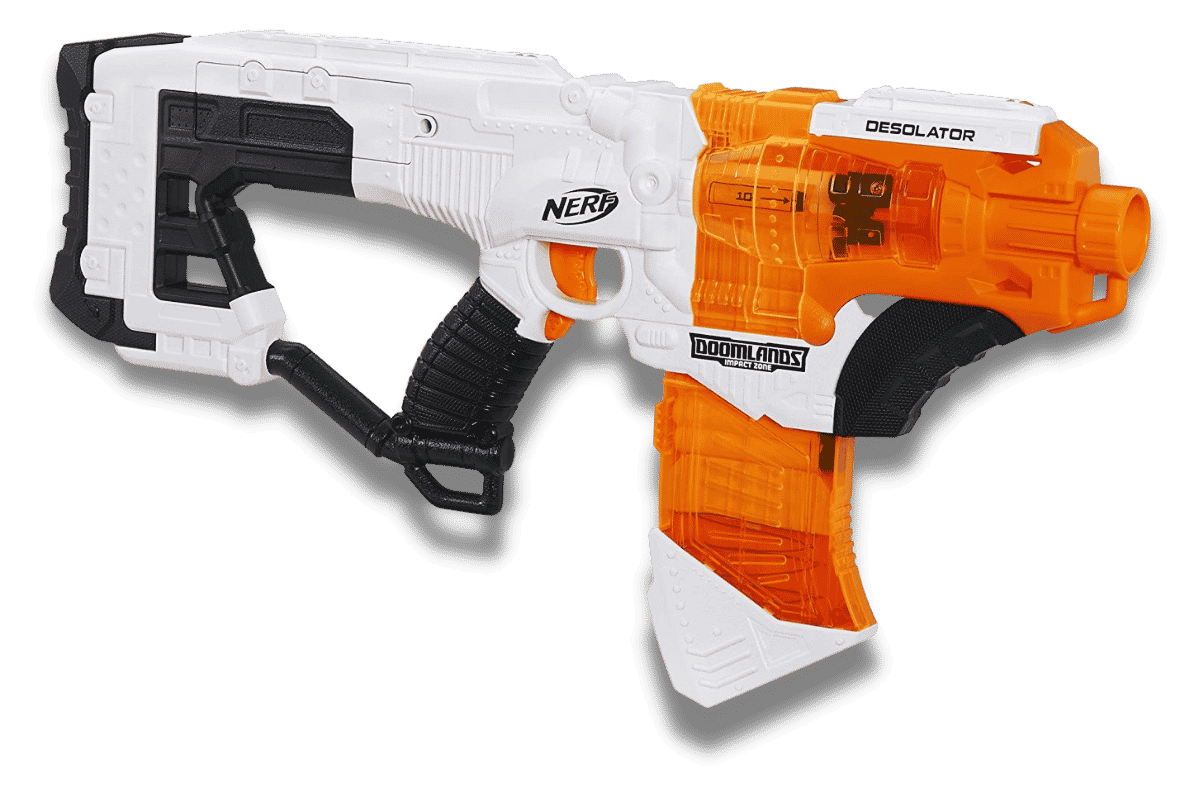
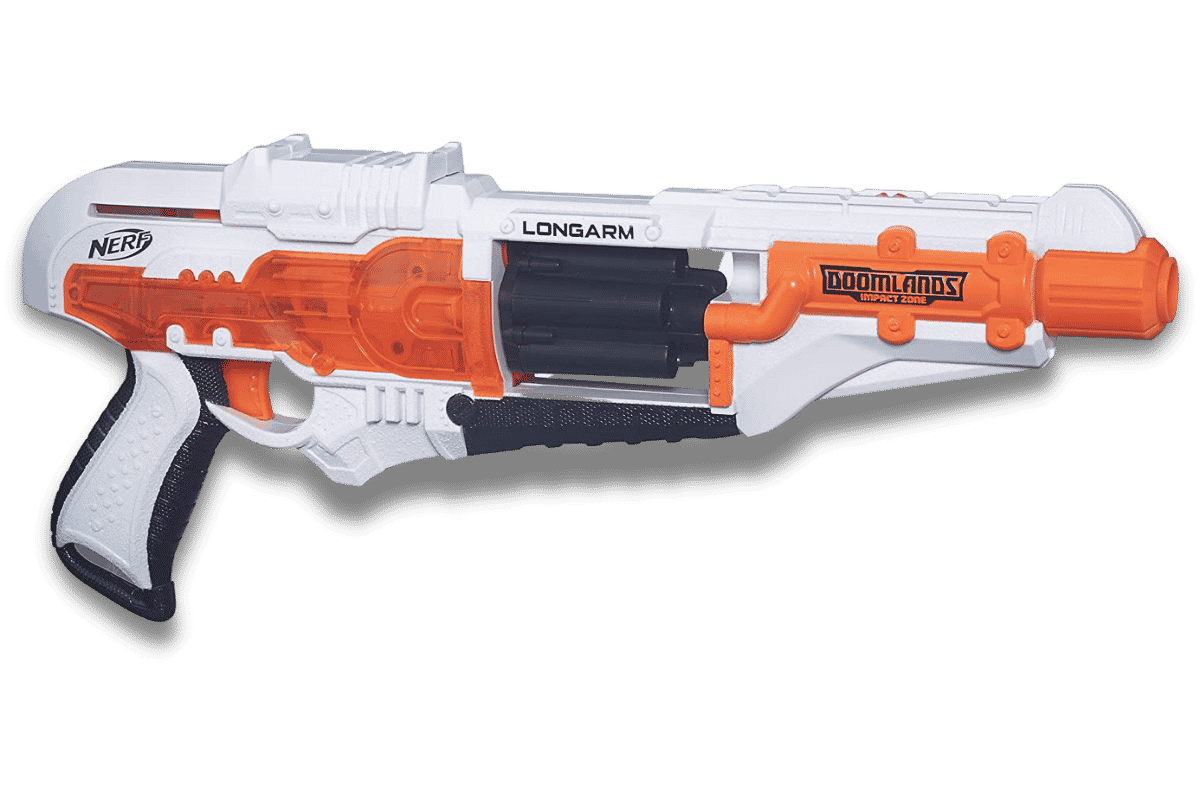
Two blasters, two distinct tactical roles — a compact semi-auto flywheel primary and a spring-cylinder precision sidearm, both carrying the Impact Zone’s signature white and transparent orange design language.
Impact Zone Ammo and Technical Info
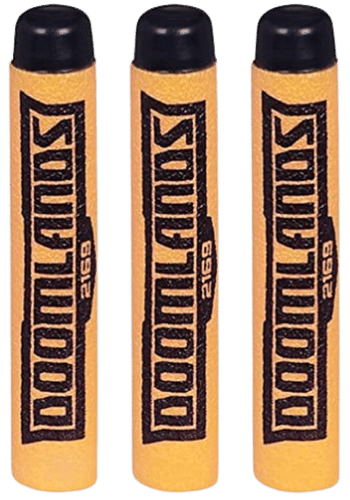
Impact Zone Darts run white body, black tip — Elite-standard dimensions with full N-Strike cross-compatibility in both directions. The Desolator’s ten-round banana clip adds translucent ammo visibility the standard Elite magazine doesn’t offer. Performance benchmarks sourced from community chronograph testing.
doomlands nerf darts
Doomlands Impact Zone blasters run on Impact Zone Darts — white body, black tip, Elite-standard dimensions across the board. The color scheme separates them from core Doomlands darts visually, but the compatibility profile is identical.
- Ammunition Cross-Compatibility: Impact Zone Darts seat smoothly into any N-Strike Elite blaster, and standard Elite darts load into either Impact Zone blaster without friction.
- The Banana Clip Advantage: The Desolator carries a ten-round curved banana magazine with a translucent orange side panel along the spine. The operator reads the ammo count mid-firefight without ejecting the magazine — a practical advantage standard N-Strike box magazines lack. Its curved geometry and white custom bumper make it visually distinctive, frequently adopted by the community on non-Impact Zone Nerf guns. Standard N-Strike Elite magazines slot into the Desolator’s magwell without modification, and the banana clip fits into any N-Strike-compatible magwell in return.
- The Five-Dart Cylinder: The Longarm runs a five-dart spring cylinder — one round below the standard six-dart revolver benchmark. The cylinder drop mechanism exposes only one chamber at a time during loading, slowing the process compared to open-face cylinder designs.
- Zero Modularity: Neither blaster accepts N-Strike barrel attachments or stock extensions. Both omit the front barrel lug by design, leaving tactical rails and sling mounts as the only accessory points.
The Desolator’s logistics package supports an operator who can’t afford to guess dart count in a close-quarters firefight. The Longarm’s five-dart ceiling is the counterbalance. A compact sidearm with one reload cycle shorter than most.
The Impact Zone ecosystem is defined by what the Desolator inherits and what both blasters deliberately omit — Stryfe internals on one side, N-Strike attachment points on the other. The two-blaster lineup is narrow; the ecosystem story is not.
The Stryfe Heritage: The Desolator’s defining characteristic isn’t its white color scheme — it’s the flywheel mechanism running beneath it. The internals share almost identical architecture with the Nerf Stryfe, giving the Desolator access to the Stryfe’s full aftermarket ecosystem: motors, switches, and LiPo battery conversions documented across years of community modification.
Zero modularity is the deliberate trade: Neither blaster carries an N-Strike barrel lug or stock attachment point — the Impact Zone aesthetic rejected the N-Strike attachment vocabulary entirely. The Desolator compensates with an integrated thumbhole stock built into the shell; the Longarm offers nothing equivalent.
The transparent panel is the ecosystem’s visual signature: A clear side window runs along the Desolator’s shell, exposing the flywheel cage during operation — design language from the parent Doomlands lineup, carried into the Impact Zone color scheme and extended into the magazine well. The banana clip’s translucent side panel continues the visibility line from shell to ammo stack. No other Nerf gun in the pipeline does both.
The Stryfe heritage is the ecosystem’s most consequential detail — not the color scheme, not the retail channel. For the operator looking to modify, it’s a Stryfe-equivalent platform with confirmed aftermarket depth inside an Impact Zone shell.
Impact Zone strips away the bulky, oversized frames of its parent line to solve a single problem: confined spaces. Pushing through doorways requires a compact, lightweight platform that doesn’t dictate your stance. Two blasters, two distinct tactical roles. Neither one is a general-purpose combat loadout.
Precision-Integrated Hardware: The Desolator fills the primary role — a compact semi-auto flywheel easy to maneuver around obstacles. The Longarm fills the sidearm role: a spring-cylinder backup for when the primary runs dry. The design narrative builds around the same Lone Hero — but where core Doomlands hardware looks improvised and weathered, Impact Zone hardware looks precision-integrated, purpose-built for a hostile frozen environment.
Ergonomic and Tactical Trade-offs: The trade-offs are real. The Desolator’s trigger frame can feel cramped — the short reach to the trigger causes hand fatigue in extended sessions for adults or anyone with larger hands. The Longarm’s five-dart ceiling and loading restriction mean a slow reload under pressure with no slam-fire to compensate. Zero modularity compounds the issue: no barrel extensions, no adjustable stocks, and no cross-series customization on either blaster. The aesthetic traded the entire N-Strike attachment vocabulary for an integrated, non-removable design.
The two-blaster architecture is the point — a primary and a sidearm in a loadout light enough to stay mobile. The Desolator handles the engagement. The Longarm handles the backup plan.
The Impact Zone’s Tactical Strengths belong almost entirely to the Desolator — Stryfe internals, a smooth stock trigger the standard Stryfe can’t match, and access to one of the most established modification ecosystems in Nerf. The Longarm has a defined sidearm role. The Desolator has a performance argument.
Stryfe-Equivalent Architecture: The Desolator and the Nerf Stryfe share almost identical flywheel architecture — the same internal footprint, the same motor housings, the same basic wiring layout. The community treated this inheritance as an advantage from launch: the Desolator functions as a Stryfe-equivalent primary in an Impact Zone shell, carrying every compatibility advantage the Stryfe platform offers without the Stryfe’s aesthetic.
Modification Ecosystem: The modification potential is the Stryfe ecosystem applied directly to the Desolator. Motor upgrades, switch replacements, and LiPo battery conversions transfer to the Desolator’s identical internal footprint without adjustment. The community runs the Desolator as a shell replacement for the Stryfe in superstock builds, rewiring and upgrading the internals to competitive speeds that far exceed the stock flywheel output. Confirmed Aftermarket Depth — inherited from the Stryfe platform, not built from scratch.
Unrestricted Trigger Pull: The Desolator’s trigger pull is unrestricted out of the box. The electronic locks that restrict the Stryfe’s stock trigger are absent, delivering a feel that reviewers consistently compared to a modified Stryfe. For operators who need fast trigger response in confined engagements, this is the gap: the Desolator arrives there stock; comparable flywheel blasters don’t.
The three strengths compound: Stryfe-equivalent internals, full modification access, and a stock trigger that performs like a modified blaster. The platform is the advantage.
The Desolator’s single-shot performance lands between 67 and 73 FPS with ranges of 42 to 57 feet on a fully-revved trigger pull (community chronograph testing by Coop772, CJ Nerf, and Randomshadow09). Sustained fire tells a different story — the same blaster drops to 25 to 34 feet during rapid sequences. The gap between those two numbers is the section’s subject.
Flywheel Recovery Time: The cause is the flywheel system. The Desolator’s stock motors recover slowly between trigger pulls. Semi-auto flywheel blasters need the motors to reach full spin speed before a dart enters the barrel — a dart fired against partially-spun wheels loses velocity.
The Sustained Fire Ceiling: In single-fire mode with time between shots, the wheels reach full speed and performance holds. In rapid-fire sequences — pulling the trigger faster than the motors can recover — each successive dart enters against partially-spun wheels. The result is a sustained fire ceiling: the point at which rapid trigger pulls stop delivering effective range. Operators who push into sustained rapid-fire sequences will find range dropping to 25 to 34 feet — putting both blasters at roughly the same effective distance and removing the range separation the two-blaster loadout depends on. Motor upgrades and LiPo battery conversions raise the ceiling toward competitive performance.
The Desolator is a single-shot and short-burst performer — accurate, smooth, and fast in controlled fire. Push it past that and the range data tells the operator where the ceiling is.
Impact Zone Intel: Trending Guides and Nerf Gun Case Studies

The Evolution of Nerf Guns Post 2021 – On Track To Where?
Keith2026-01-26T19:01:26+00:00
DinoSquad Nerf Guns – Can These Dino Blasters Deliver
Keith2026-01-26T13:46:56+00:00