Rival Nerf Guns
Rival Nerf Guns were designed with purpose — control the opposition and leave them no opportunity to respond. That dominance comes at a cost only the CQB Heavyweight is built to absorb, and a modification scene deep enough to push it further still.
Nerf Rival Series Directive: Dominating CQB Through Raw Velocity
Rival runs on one premise across all 31 Nerf guns spanning 2015 to 2024, organized into five distinct sub-series arsenals — overwhelm the opponent with velocity and volume before they have time to react. A 90 to 100 FPS baseline hits roughly 20 to 30 FPS harder than the standard Elite Par, and hopper-fed primaries turn ammunition capacity into a non-issue rather than a tactical liability. The Perses MXIX-5000 pushes that baseline further still, averaging 104 FPS as the lineup’s proven hot performer.
Close-quarters engagements are decided in real-time under this doctrine — the CQB Heavyweight wins them through raw stopping power, not careful positioning. That edge costs real comfort: oversized adult-friendly grips, heavy prime strokes on spring platforms, and rounds that curve unpredictably past 40 feet. The trade-off is the entire point — and for operators willing to invest further, Rival carries the deepest established modification community of any series in the pipeline.
Hasbro’s 2019 fix for a competitor problem fractured compatibility within Rival’s own lineup by 2024 — the Pathfinder, Challenger, and Mirage all inherited it. Performance data, the full modification ecosystem, and that compatibility story are documented in the sections below.

Ages 14+

$30-225

Average Rating 4.5

High-Impact Rounds

100 FPS
| Series | # of Blasters | Ammo | Magazine/Cylinder Capacity (Low–Max) |
Avg Velocity | Technical Highlights |
|---|---|---|---|---|---|
| Accustrike | 10 | AccuStrike Elite Darts | 1–25 | 70 FPS | Superior Accuracy Focus |
| Elite 2.0 | 15 | Elite 2.0 Darts | 1–18 | 80 FPS | Tactical Arsenal, Customization |
| Zombie Strike | 23 | N-Strike Elite Darts | 1–25 | 65 FPS | Zombie Theme, Tactical |
| Modulus | 20 | N-Strike Elite Darts | 1–12 | 68 FPS | Tactical Arsenal, Customization |
| Alpha Strike | 17 | Elite Nerf Darts | 1–10 | 65 FPS | Budget Blasters, Tactical, Simplistic |
| Impact Zone | 2 | Elite Nerf Darts | 5–10 | 71 FPS | Apocalyptic Theme, Adventure |
| Doomlands 2169 | 7 | Elite Nerf Darts | 1–30 | 69 FPS | Futuristic Theme, Doomsday |
| Ultra | 14 | Ultra Nerf Darts | 1–25 | 94 FPS | Tactical Arsenal, Futuristic, Accuracy |
| Mega | 14 | Mega Nerf Darts | 1–24 | 73 FPS | Tactical Arsenal, Oversized, Accuracy |
| Hyper | 6 | Hyper-Rounds | 20–100 | 107 FPS | Tactical, Futuristic, High-Capacity |
| Rival | 18 | High-Impact/Accu-Rounds | 1–100 | 94 FPS | Tactical, High-Capacity, Accuracy (14+ Eye Pro) |
Rival Nerf Guns Arsenal: Full Lineup, Hopper-Fed Dominance Across Every Format
Thirty-one Nerf guns spanning a decade of CQB dominance — hopper-fed primaries, spring-powered sidearms, and five distinct arsenals built to clear a room: primary focus is velocity and volume over precision.
Apollo XV-700 [single-fire | 96 FPS]
artemis XVII-3000 [single/slam-fire | 89 FPS]
atlas XVI-1200 [multi/slam-fire | 91 FPS]
charger MXX-1200 [semi-automatic | 98 FPS]
challenger MXXIV-1200 [semi-automatic | 98 FPS]
fate XXII-100 [single-fire | 96 FPS]
finisher XX-700 [single-fire | 92 FPS]
khaos MXVI-4000 [single-fire | 92 FPS]
nemesis MXVII-10K [automatic | 102 FPS]
kronos XVII-500 [single-fire | 90 FPS]
knockout XX-100 [single-fire | 93 FPS]
hypnos XIX-1200 [single-fire | 100 FPS]
helios XVIII-700 [single-fire | 97 FPS]
finisher xx-700 [single-fire | 92 FPS]
roundhouse XX-1500 [single-fire | 99 FPS]
perses MXIX-5000 [automatic | 104 FPS]
zeus MXV-1200 [semi-auto | 89 FPS]
takedown XX-800 [single-fire | 96 FPS]
pathfinder XXII-1200 [single-fire | 92 FPS]
vision XXII-800 [single-fire | 99 FPS]
Forerunner XXIII-1200 [single-fire | 103 FPS]
Pilot XXIII-100 [single-fire | 93 FPS]
Mirage XXIV-800 [single-fire | 95 FPS]
Rival Ammo and Technical Info
Rival fires 7/8-inch spherical High-Impact Rounds — completely incompatible with standard Nerf darts, the only ammunition format change in the pipeline rather than a cosmetic variant. Performance benchmarks sourced from community chronograph testing by Coop772 and multiple verified community reviewers.
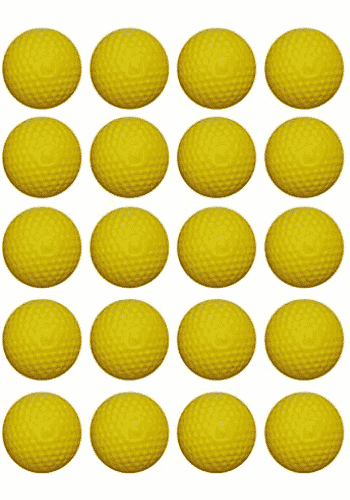
high-impact rival rounds
Rival Nerf Guns fire High-Impact Rounds — 7/8-inch spherical foam balls completely incompatible with standard Nerf darts. The newer blue Accu-Rounds carry a revised dimple pattern marketed as more accurate, though extensive testing by Coop772 and WalcomS7 found the two ammo types perform identically. No discernible difference in spread or accuracy — a conclusion LordDraconical's independent testing corroborated.
Hopper-fed capacity is the platform's defining architectural shift. Early high-capacity blasters relied on bulky proprietary magazines that were slow and frustrating to reload mid-engagement. The Nemesis changed that calculus — a 100-round gravity-fed hopper that lets the operator dump loose rounds directly into the blaster, eliminating the reload entirely as a tactical pause point. The Perses runs a 50-round hopper in a compact SMG-format body — the aftermarket modification community has pushed that capacity considerably further, documented in Modification Intel. The Prometheus scales the format to 200 rounds in a hip-fired heavyweight build. The trade-off is orientation: gravity-fed hoppers depend on the blaster staying mostly upright — tilt or invert it during a dive or a corner peek, and the internal conveyor belt dry-fires instead of feeding.
Stick magazines tell a more fractured story. Standard format runs 7-round or 12-round clear tubes, broadly cross-compatible across most of the lineup — but several blasters break that pattern in ways worth knowing before a purchase.
The Khaos MXVI-4000 runs a completely proprietary 40-round magazine with no cross-compatibility to the standard stick format.
The Finisher XX-700 accepts standard 7-round and 12-round Rival magazines without issue — the incompatibility runs the other direction. Its own proprietary quick-load magazine carries a special notch that prevents it from working in any other Rival blaster.
The Zeus MXV-1200 can't securely lock the smaller 7-round magazines into place — a fit issue specific to that platform's magwell tolerance.
The Pathfinder, Challenger, and Mirage carry the most consequential compatibility story in the lineup. To block cross-brand use with competitors like Dart Zone, Hasbro molded small plastic nubs onto the back of 12-round magazines starting in 2019. The change worked as intended against outside competition — but all three of these newer blasters were engineered around the nubs, which means older flat-backed Rival magazines from the brand's own earlier blasters sit too loosely in the mag-well, causing jams and failure-to-chamber issues. A compatibility lockout designed for competitors ended up fracturing compatibility within Rival's own product line.
For the CQB Heavyweight, the logistics picture rewards research before purchase — hopper-fed primaries solve capacity outright, but magazine-fed secondaries demand checking which specific blaster a magazine was designed for, not just which series it belongs to.
Five distinct sub-series branch off the core Rival lineup, each repackaging proven hardware for a different purpose — some mechanical, some cosmetic, one licensed entirely outside the Rival identity. A sixth, the Camo Series, earned its own dedicated page given its depth.
Curve Shot is the lineup's most mechanically distinct branch. The Flex, Sideswipe, and Helix all feature an adjustable muzzle that intentionally bends a fired round's trajectory left, right, or downward — a genuine mechanical novelty rather than a cosmetic variant, built for shooting around cover or corners rather than maximizing straight-line velocity.
Edge Series trades combat performance for target practice — lime-green blasters and ammunition including the bolt-action Jupiter and Mercury, built for plinking and precision drills rather than CQB engagements.
Accu-Rival layers blue Accu-Rounds, optimized barrels, and adjustable iron sights onto existing platforms under an accuracy-focused marketing banner. The round performance claim doesn't hold up under testing — covered in Logistics & Payload — but the iron sights and barrel work remain genuine hardware additions for operators who want them regardless of the ammo claim.
Phantom Corps is the lore and livery tier — white-and-black blasters bundled with interchangeable red and blue team ribbons for organized team play. No mechanical differentiation; the value is entirely in team identification during group games.
Licensed Props extends the Rival platform into Overwatch, Star Wars, and Deadpool crossover territory — McCree, Reaper, D.Va, and Soldier 76 from Overwatch; a Mandalorian Apollo and Stormtrooper variant from Star Wars; Kronos and Apollo reskins under the Deadpool banner. Performance varies by build type, not by license. The Star Wars Mandalorian Apollo and the Deadpool Kronos are direct mechanical reskins of their mainline counterparts, chronographing at 98 FPS and 90 FPS respectively — full mainline performance under a cosmetic shell.
The Overwatch line runs more mixed: D.Va lands close to baseline at 89 FPS, while McCree — built as a unique single-shot prop rather than a reskin of an existing platform — chronographs at a sluggish 74 FPS, as documented by Coop772. The license itself isn't the performance tax. The build type is.
Rival's accessory ecosystem runs on proprietary rails — Picatinny-style, but incompatible with standard N-Strike attachments, which means N-Strike scopes and grips bought for other series won't transfer here. The rechargeable battery pack is the most consequential accessory in the lineup — Coop772's testing confirmed it lifts the Nemesis from 98 FPS on alkaline batteries to 102 FPS on the rechargeable pack, alongside a rate-of-fire boost and significant weight reduction over disposable D-cells.
The same gain applies across other compatible flywheel platforms like the Khaos — though the pack is strictly incompatible with the Charger and the Perses, both of which use their own proprietary battery format. Beyond the battery, the accessory catalog stays modest: a red dot sight, a flashlight grip, face masks and vision gear for eye protection, and battle cases or tactical pouches for carrying spare rounds and magazines into the field.
For the CQB Heavyweight, the ecosystem decision is about purpose, not platform — Curve Shot and Edge Series genuinely change what the blaster does, while Phantom Corps, Accu-Rival, and Licensed Props change what it looks like and where it came from, sometimes at a real velocity cost.
The Rival lineup runs one CQB doctrine across all 31 Nerf guns — overwhelm the opponent with velocity and volume before they can react, then keep applying pressure. The CQB Heavyweight is the operator built for that doctrine: not precision, not range, but the firepower to close a fight in seconds. Every design decision in the series traces back to that single premise.
The accuracy trade-off is the cost of the velocity. As WalcomS7 verified in testing, Rival's spherical rounds hold a tight, accurate path for roughly 30 to 40 feet before they begin to curve unpredictably in a random direction. A non-issue at CQB range, but a real liability for anyone trying to stretch a Rival blaster into a long-range role it wasn't built for. The hopper-fed primaries that define the lineup's reload speed carry their own constraint — Coop772's testing of the Nemesis confirmed that gravity-fed hoppers depend entirely on the blaster staying upright; invert it or tilt it sharply during a dive or a parkour-style maneuver, and the feed system stops working because gravity is no longer pulling rounds into the conveyor.
The physical costs are accessibility costs. Rival's grips run oversized and adult-friendly across the board — a deliberate design choice that serves the series' adult-skewing competitive audience well but makes the lineup a harder fit for younger or smaller-handed operators than dart-based series with more compact frames. Spring-powered platforms compound it: top-prime and pump-action blasters demand a stiff, heavy prime stroke that can be genuinely exhausting over a long engagement. As WalcomS7 also noted, the dense, durable spherical rounds bounce heavily on impact — a real nuisance for tracking down spent ammunition in outdoor grass compared to the dart-based series where rounds drop and stay put.
For the CQB Heavyweight, none of these costs change the calculus. A blaster that curves past 40 feet, demands an upright stance, and exhausts the priming arm is still the correct choice when the engagement is decided in the first three seconds. Rival wasn't built to be comfortable. It was built to win the room.
Rival Nerf guns deliver two structural advantages that define the CQB Heavyweight's edge — velocity that outperforms the rest of the Nerf ecosystem by a wide margin, and a reload architecture that turns capacity into a non-issue. Verified: Rival's 90 to 100 FPS baseline is community-confirmed, not a marketing claim corrected downward.
At 90 to 100 FPS, the standard Rival blaster hits roughly 20 to 30 FPS harder than the ~70 FPS Elite Par that defines most of the Nerf ecosystem — a gap wide enough that opponents running dart-based blasters lose meaningfully on stopping power and reaction time at CQB range. That velocity advantage is what built the lineup's standing in the competitive scene: Rival is the established choice for indoor CQB arena play and organized competitive leagues, where the velocity gap between Rival and everything else decides engagements before either side has time to out-position the other.
The Nemesis defines the second advantage. Its 100-round gravity-fed hopper eliminates the magazine reload entirely — operators dump loose rounds directly into the blaster instead of fumbling a magazine swap mid-engagement, removing what reviewers at the time hailed as the "grunt work" that slowed down every magazine-fed competitor before it. That reload architecture, paired with the velocity edge above, is what makes hopper-fed primaries the standard pick for HvZ and other sustained-engagement formats where staying in the fight matters more than any single shot. Full lineup-wide FPS benchmarks and the Perses' standout 104 FPS outlier are documented in Field Notes; the lithium and flywheel upgrades that push modded performance even further appear in Modification Intel.
For the end user, the math is simple — velocity wins the exchange before it starts, and hopper capacity means the operator never has to stop fighting to reload. Nothing else in the Nerf ecosystem stacks both advantages at this scale.
Rival's 90 to 100 FPS baseline isn't a debunked marketing number waiting for a correction — it's Verified, confirmed by community chronograph testing across the lineup since the 2015 launch. The Apollo and Nemesis both hit the high 90s to over 100 FPS straight out of the box, and the numbers have held up consistently across nearly a decade of independent testing.
Hasbro's 2020 packaging adjustment is the rare case where a manufacturer correction made a claim more accurate, not less. The Takedown and Charger had their advertised numbers revised down to 90 FPS and 95 FPS respectively. Field testing confirmed both blasters land in that range, with results fluctuating by reviewer and the Charger frequently running hot at 98 FPS. Reviewers still praised the adjustment as unusual. That's the Verified standard at its best: numbers on the box that hold up — or get beaten — on the chronograph.
The Perses MXIX-5000 is the lineup's proven hot performer — averaging 104 FPS, well above the series baseline, in a compact SMG-format body that also carries the fastest rate of fire in the entire 31-blaster catalog. That combination — above-baseline velocity paired with the highest rate of fire — makes the Perses the closest thing the lineup has to a flagship overperformer, distinct from blasters that simply meet the advertised number.
The Zeus MXV-1200 sits at the opposite end of the mainline spread, averaging 85 to 89 FPS — the one early-lineup blaster that consistently lands below the 90 FPS floor. The Atlas tells a different story entirely: advertised at a modest 80 FPS, independent testing actually puts it at 86 to 91 FPS — a manufacturer claim debunked in the generous direction, rare enough in the toy industry to be worth noting on its own. The Licensed Props tier carries its own separate performance variance, covered in Ecosystem.
All things concidered, the benchmark spread is purchase intelligence — nearly every mainline blaster meets or exceeds the 90 FPS standard, the Perses rewards operators chasing the hottest stock option, and the Zeus is the one early pick that genuinely undersells the series' core promise.
Rival sits at the top of the pipeline's modification depth — Confirmed Aftermarket Depth, with named vendors, documented procedures, and a 3D-printed parts ecosystem spanning springer platforms and flywheel electronics alike. The Kronos and Takedown anchor the spring-upgrade side. The Nemesis, Khaos, and Perses anchor the electrical side. Both paths demand real investment before they pay off.
Springer Platform Upgrades. The Kronos and Takedown share a robust internal platform the spring-upgrade community has standardized around. K25, K26, and Pro RX springs are the established power upgrades — Coop772's testing shows K26 springs run roughly 12 to 14 inches and need trimming and recoiling to fit the Kronos without plunger flop. His chronograph testing also confirms a no-new-parts alternative: 3D-printed spring spacers add pre-compression that pushes a stock Kronos from 84 to 98 FPS.
Silver Fox Industries produces the platform's premium upgrade path — a carbon fiber or aluminum lever-action conversion kit for the Takedown, showcased in detail by WalcomS7. Not every spring-friendly blaster is forgiving: justajolt's review of the Helios found plastic priming gears thin enough to earn the nickname "cheese grate quality" — a spring upgrade puts enough stress on those teeth to make breakage a real risk.
Flywheel and Lithium Conversions. Rival's hopper-fed flywheel primaries — the Nemesis, Khaos, and Perses — share the same electrical reality: a full rewire is mandatory before a LiPo battery delivers real performance gain. Stock wiring can't handle the voltage jump a 3S LiPo demands, so modders gut the factory wiring for 16-gauge silicone wire and XT60 or XT30 connectors built for the higher current draw. The Perses stands out for a reliability feature worth noting on its own: built-in PTC thermistors on both flywheels and the main motor lead that detect a jammed ball, cut power automatically, and save the motors from burning out — a stock safeguard that survives the upgrade conversation.
Confirmed Aftermarket Depth. Rival's aftermarket runs on named, established vendors — Out of Darts, Foam Technician, Silver Fox Industries, and Foam Pro Shop all maintain established product lines for the platform. The Perses carries two upgrade paths, both engineered by Luke at Out of Darts: a dual-driver MOSFET board with PWM control adding adjustable rate-of-fire while retaining motor braking, and a 3D-printed hopper extension that more than triples the stock 50-round capacity.
The Kronos gets its own accessory category — door-delete kits and speed loaders from Foam Technician. As noted in LordDraconical's modding teardowns, the Pathfinder is a caution worth flagging: its fitted molded shell pieces — used in place of internal screws — bow under heavy spring loads, and the screws it does use strip easily during disassembly. A platform built more for cosmetics than structural headroom.
For the CQB Heavyweight, modification depth here means the platform doesn't stop where the factory line does — springer platforms scale with named spring vendors, flywheel platforms scale with a recorded wiring standard, and the Perses alone offers two upgrade paths plus a stock safeguard that protects the investment. Few series in the pipeline reward the time this completely.
All Rival Nerf guns use High-Impact Rounds and is the only ammunition that’s compatible with these blasters. They have a high level of durability, however, abrasions and such will affect performance. Caution not to mistake these with Hyper rounds which are NOT compatible with Rival blaster, nor will High-Impact Rounds work in Hyper Nerf guns.
HIGH-IMPACT ACCU-ROUNDS
Accu-Rounds are the latest Rival ammo to be released. They are blue in color and are supposed to have an increased accuracy over the original High-Impact Rounds. This ammo will be compatible with all Rival Nerf guns and will be sold separately, although, they will come packaged with the 3 new guns.
The tactical diversity within the Rival lineup is genuinely impressive, spanning everything from precision single-shot platforms to high-capacity automatic systems that can lay down sustained suppressive fire. You’ll find an unusually robust selection of motorized blasters in this series, each engineered to handle the unique cycling requirements for High-Impact rounds. Whether you’re looking for a compact sidearm, a versatile primary weapon, or a crew-served support blaster, Nerf Rival offers platforms that can anchor serious tactical loadouts.
Nerf Rival occupies the tactical middle ground between traditional Elite dart systems and the newer Hyper series. While Elite blasters rely on foam darts that can be inconsistent at longer ranges, Rival’s High-Impact Rounds deliver more consistent flight paths. The key difference lies in the design—Rival balls maintain their trajectory better than darts but don’t quite match the raw velocity of Hyper rounds.
From a tactical standpoint, Nerf Rival blasters typically offer better range and accuracy than Elite systems while being more forgiving than Hyper platforms. The series also features an impressive selection of high-capacity automatic systems that aren’t as prevalent in other lines. If you’re looking for the sweet spot between performance and accessibility, Rival delivers that balanced approach.
Rival Intel: Trending Guides and Nerf Gun Case Studies

The Evolution of Nerf Guns Post 2021 – On Track To Where?
Keith2026-01-26T19:01:26+00:00

DinoSquad Nerf Guns – Can These Dino Blasters Deliver
Keith2026-01-26T13:46:56+00:00