Zombie Strike Power Shock Nerf Guns
Zombie Strike Power Shock Nerf Guns bring integrated lights and sounds to every firefight — two blasters built for the HvZ operator who wants the full post-apocalyptic experience, not just the performance numbers. The Revoltinator’s 112-130 FPS modification ceiling is the story behind the aesthetic.
Nerf Power Shock Directive: Electrified Scrap Aesthetic Built for HvZ Combat
Power Shock is a two-blaster sub-series of Nerf Zombie Strike — post-apocalyptic scrap aesthetic, integrated electronics that activate with every trigger pull, and a Revoltinator flywheel primary with a documented 112-130 FPS modification ceiling and a Stryfe-derived parts ecosystem to get there. The Revoltinator is the investment piece. The Contractor is the slam-fire secondary.
The HvZ Immersionist is the operator the lineup was built for — theatrical, mobile, and willing to trade stealth capability for a loadout that announces itself with lights and sound. Built-in electronics carry no off switch. The trade is deliberate. Get in close, stay loud, and let the Revoltinator’s modification ceiling do the rest.
The Contractor launched as a Meijer regional exclusive — a distribution story that limited its community footprint and contributed to discontinuation alongside the Revoltinator. Both Nerf guns now live on secondary markets. Performance data, modification depth, and the no-switch stealth trade-off are documented in the sections below.

Ages 8+

$55-75

Average Rating 4.6

Zombie Strike Darts

Animated Lights & Sounds
| Series | # of Blasters | Ammo | Magazine/Cylinder Capacity (Low–Max) |
Avg Velocity | Technical Highlights |
|---|---|---|---|---|---|
| Accustrike | 10 | AccuStrike Elite Darts | 1–25 | 70 FPS | Superior Accuracy Focus |
| Elite 2.0 | 15 | Elite 2.0 Darts | 1–18 | 80 FPS | Tactical Arsenal, Customization |
| Zombie Strike | 23 | N-Strike Elite Darts | 1–25 | 65 FPS | Zombie Theme, Tactical |
| Modulus | 20 | N-Strike Elite Darts | 1–12 | 68 FPS | Tactical Arsenal, Customization |
| Alpha Strike | 17 | Elite Nerf Darts | 1–10 | 65 FPS | Budget Blasters, Tactical, Simplistic |
| Power Shock | 2 | Zombie Nerf Darts | 8–18 | 68 FPS | Zombie Apocalyps Theme, Animated Blasters |
| Doomlands 2169 | 7 | Elite Nerf Darts | 1–30 | 69 FPS | Futuristic Theme, Doomsday |
| Ultra | 14 | Ultra Nerf Darts | 1–25 | 94 FPS | Tactical Arsenal, Futuristic, Accuracy |
| Mega | 14 | Mega Nerf Darts | 1–24 | 73 FPS | Tactical Arsenal, Oversized, Accuracy |
| Hyper | 6 | Hyper-Rounds | 20–100 | 107 FPS | Tactical, Futuristic, High-Capacity |
| Rival | 18 | High-Impact/Accu-Rounds | 1–100 | 94 FPS | Tactical, High-Capacity, Accuracy (14+ Eye Pro) |
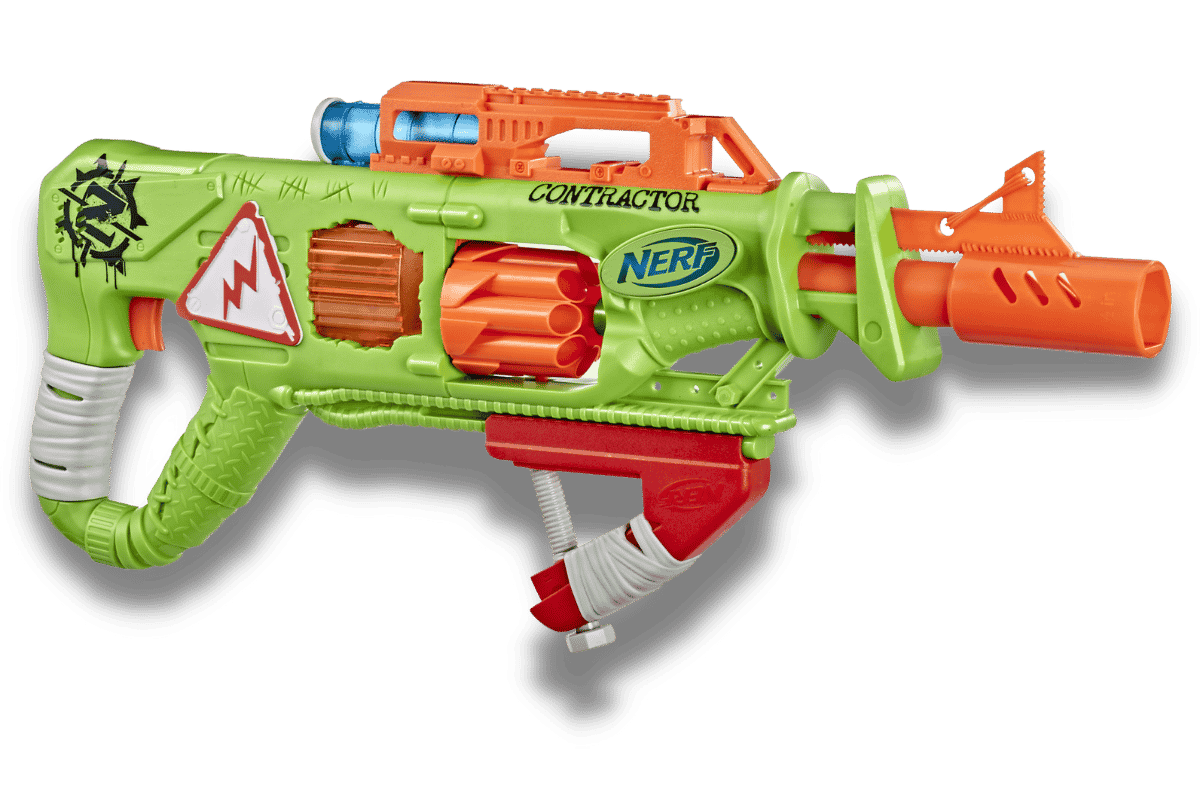
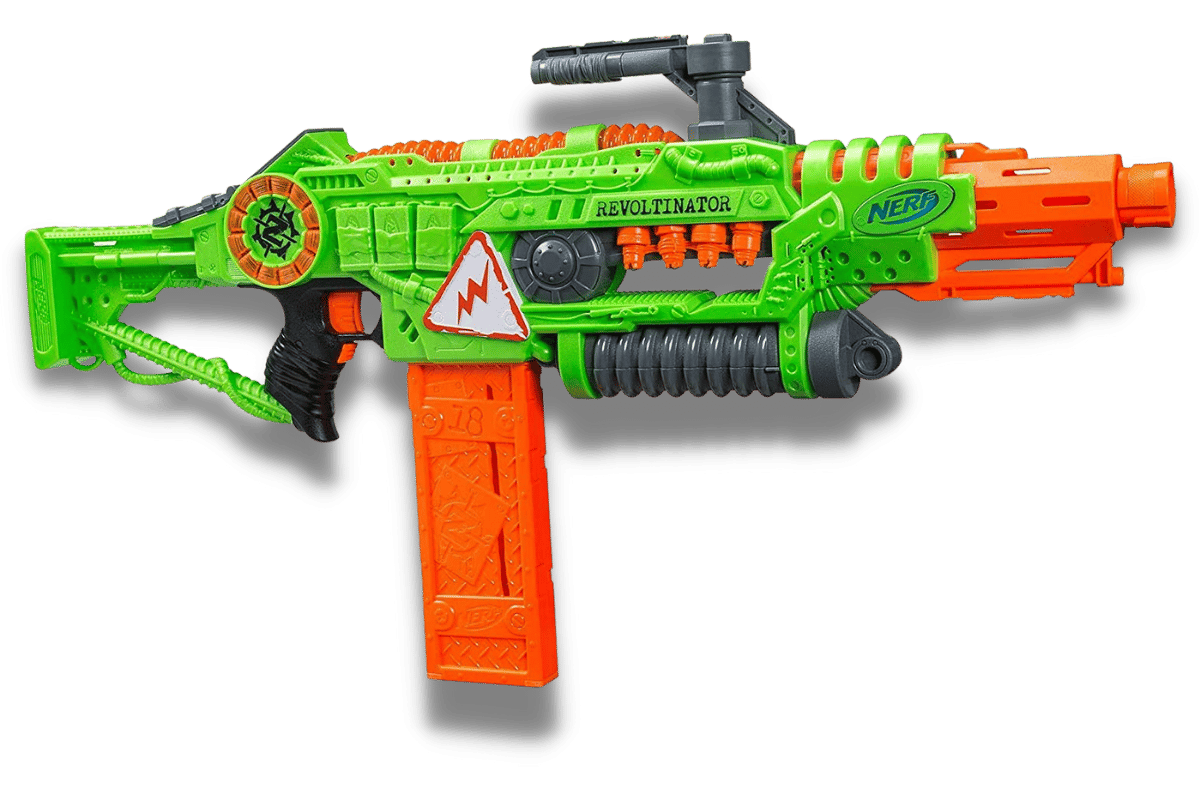
Power Shock Nerf Guns Arsenal: Lights-and-Sounds Flywheel and Slam-Fire Revolver
Two blasters sharing one design principle — post-apocalyptic scrap hardware with integrated electronics that light up and rev with every trigger pull. Flywheel primary and slam-fire secondary, both built around the HvZ aesthetic first.
Power Shock Ammo and Technical Info
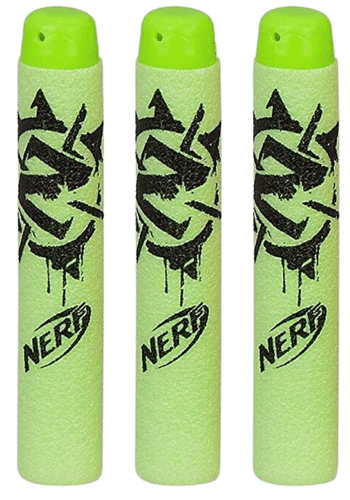
Power Shock runs green Zombie Strike Elite Darts — Elite-standard dimensions with full N-Strike cross-compatibility in both directions. The community recommends waffle head darts for improved accuracy across both platforms. Performance benchmarks sourced from community chronograph testing by multiple documented community reviewers.
zombie strike nerf darts
Zombie Strike Power Shock runs series-specific Elite Darts — green bodies, flexible hollow tips, and full cross-compatibility with the standard N-Strike Elite ecosystem in both directions. While standard Elite darts load flawlessly, testing by community reviewers like Naptown Nerf and LordDraconical has proven that third-party ‘waffle head’ darts significantly improve the blaster’s accuracy and flight consistency across both platforms.
The Revoltinator’s 18-round magazine is the section’s defining logistics detail. The magazine runs thicker than a standard N-Strike Elite clip and features an open hollow window for ammo level checks. It also carries a custom simulated diamond-plate and rubberized end-caps that extends the Power Shock’s junkyard visual identity into the loadout. Standard N-Strike Elite magazines slot into the Revoltinator’s magwell — the reverse holds true, and the 18-round magazine seats in any compatible N-Strike blaster.
The Revoltinator also carries an N-Strike barrel lug at the front, accepting Zombie Strike barrel extensions and standard N-Strike barrels without modification. The integrated shoulder stock is fixed — aftermarket stocks cannot be attached. Full ammo and magazine cross-compatibility detail for the broader Zombie Strike family lives on the Zombie Strike page.
The Contractor runs an 8-dart rotating cylinder with slam-fire capable pump-action priming. The cylinder does not drop out for loading — darts are fed one slot at a time through the open chamber face, which slows the reload process significantly. No barrel attachment point and no stock attachment point are present on the Contractor.
For the HvZ Immersionist, the Revoltinator’s 18-round capacity and quick magazine swap are the logistics foundation of the primary role — the Contractor’s 8-dart ceiling and slow reload define it as the secondary option when the Revoltinator is down.
The Revoltinator shares its core motor-driven flywheel architecture with the Nerf Stryfe — same basic electrical layout, same motor housing format — but the flywheel cage is not a standard Stryfe drop-in. As documented by LordDraconical and corroborated by Jared Guynes, the cage geometry is unique to the Revoltinator; standard Stryfe aftermarket cages do not fit. Community modders source platform-specific cages, such as the Containment Crew print designed for the Revoltinator.
Motors, flywheel wheels, and electrical overhaul components from the Stryfe ecosystem transfer more readily, giving the Revoltinator access to a wide modification base built on established Stryfe knowledge — with that one critical sourcing distinction. Specific components, procedures, and the 112-130 FPS ceiling documented by Project Nerf are covered in Revoltinator Field Notes.
Power Shock introduced the first battery-powered Nerf gun in Zombie Strike’s history — the Revoltinator arrived in Fall 2019 with integrated LED lights, electronic revving sounds, and spark plug housings that flash in sequence. The electronics synchronize with the rev trigger and carry no off switch. Hasbro painted only one side of both blasters — the opposite face lacks junkyard detailing. The tactical implications of the no-switch design are examined in Tactical Lens.
As documented by LordDraconical and Blaster Hub, the Contractor launched almost exclusively through Meijer — a regional chain covering four US Midwest states — appearing on shelves with virtually no announcement. At $29.99 MSRP, reviewers concluded the value fell short for an 8-round blaster where the premium was paid entirely for the lights and sounds package. The broader Zombie Strike sub-series context lives on the Zombie Strike page.
For the HvZ Immersionist, the ecosystem split is the key purchase signal — the Revoltinator is the documented modification platform with a clear upgrade path, the Contractor is the secondary option with a documented value gap and a regional distribution history that limited its community footprint.
The HvZ Immersionist is the operator Power Shock was designed for — not the player optimizing for competitive performance, but the one who shows up to HvZ with lights flashing, sounds revving, and a post-apocalyptic narrative to match. Both Nerf guns contribute to the loadout — the Revoltinator holds the dominant primary role, the Contractor fills the secondary.
Built-in electronics are the archetype’s identity — and its primary tactical constraint. The Revoltinator’s LED lights and electronic revving sounds activate with the rev trigger and have no off switch; the Contractor’s likewise are unavoidable, activating with every prime and trigger pull. In HvZ formats where night ops and stealth positioning matter, Power Shock blasters are immediately self-identifying — there is no concealed approach option. This is purchase decision intelligence: the HvZ Immersionist is not the stealth operator. The electronics are the point of the loadout, not an oversight.
As widely noted by the Nerf community, the ergonomic trade-offs run across both blasters. The Revoltinator’s thumbhole grip can feel too small and back-heavy for many adult operators, and the stock trigger mechanism lacks the refinement of a high-end flywheel build. The Contractor’s pump grip carries an unusually steep vertical angle — reviewers compared it to a stapler — making extended sessions uncomfortable. Hasbro painted only one side of both blasters, leaving the opposite face unfinished. At $49.99 the Revoltinator was conceded acceptable value given the included batteries, magazine, and electronics; the Contractor at $29.99 was considered overpriced for an 8-round blaster where the premium went entirely to the light and sound package.
For the HvZ Immersionist, the Power Shock loadout is a deliberate trade — theatrical presence over stealth capability, immersive electronics over ergonomic refinement. The lights and sounds are not the cost of admission. They are the reason for it.
Zombie Strike Power Shock Nerf Guns deliver two distinct tactical strengths — immersive electronics that function independently of the firing mechanism, and a modification ceiling that puts the Revoltinator in competitive HvZ territory. The first is built-in. The second is earned.
The lights and sounds aren’t just aesthetic — they can operate independently of active fire. In themed scenarios and cosplay environments, keeping an empty magazine seated in the magwell activates the full light and sound sequence without loading darts, giving the blaster prop functionality on demand. The Revoltinator’s shell separates into multiple independent sections, making it a practical canvas for custom paint work and visual modification — an advantage for operators who want to extend the aesthetic beyond the stock color scheme.
The Revoltinator’s modification ceiling extends the tactical strengths into competitive territory. As documented by Chris at Project Nerf, a full electrical overhaul using Fang Revamp motors, a platform-specific Containment Crew cage, and Out of Darts mini MOSFETs pushed the platform to an average of 112 FPS with a peak of 130 FPS — with a PWM board adding variable rate-of-fire control. His build also demonstrated that the Revoltinator’s internal space accommodates full-auto pusher conversions using select-fire kits originally designed for the Stryfe. Confirmed Aftermarket Depth — named vendor, documented build, competitive HvZ performance from a stock flywheel base. Full procedures are in Revoltinator Field Notes.
For the HvZ Immersionist, the two strengths compound — the electronics make the loadout memorable on the field, the modification ceiling makes the Revoltinator worth keeping off it. A stock platform with a competitive upgrade path.
The Revoltinator hits standard Elite performance baselines, with happyfamily1004 averaging 66.5 FPS and Coop772 recording an average of 71 FPS. CJ Nerf’s range testing backs up these baselines, achieving distances of 45 to 70 feet depending on dart type. However, the Contractor runs softer — Coop772 averaged 62 FPS and BuffdaddyNerf recorded 64 FPS, with LordDraconical’s testing showing a wider spread of 63 to 73 FPS — the Contractor is the less predictable performer of the two.
Stock trigger lock is the Revoltinator’s most documented pre-modification issue — and the most consequential. The lock sits behind the rev trigger and is rather sensitive: if the rev trigger isn’t depressed perfectly before the firing trigger is pulled, the mechanism locks up mid-firefight. Community modders consistently identify trigger lock removal as the mandatory first step before any electrical or mechanical upgrade. Door jam issues are a secondary concern — the door is held in place by a small plastic nub and has been documented sliding open during active movement, occasionally opening partway mid-firefight.
The Revoltinator’s electronics introduce one modification requirement absent from standard Stryfe builds: a buck converter. Running a LiPo battery without one will damage the integrated lights — the converter regulates voltage to the electronics while the motors run at higher LiPo voltage. Complete rewiring is mandatory before any significant performance gain is achievable; the stock circuitry can’t handle the increased load without burning out.
Full-auto pusher installations require additional structural cutting — internal plastic bosses must be removed to seat the pusher mechanism correctly. With trigger lock removed, buck converter wired, and structure prepared, the platform reaches the modification ceiling Chris at Project Nerf documented in Tactical Strengths.
Modification potential for the Contractor is largely undocumented — no specific community builds are on record, with modders at most speculating about half-dart conversions. For the HvZ Immersionist, the field notes belong to one blaster. The Revoltinator is the platform that earns the work.
Doomlands 2169 Intel: Trending Guides and Nerf Gun Case Studies

The Evolution of Nerf Guns Post 2021 – On Track To Where?
Keith2026-01-26T19:01:26+00:00
DinoSquad Nerf Guns – Can These Dino Blasters Deliver
Keith2026-01-26T13:46:56+00:00